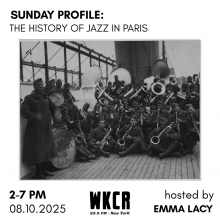
At the onset of World War I, approximately 380,000 African American soldiers joined the war effort with 200,000 of them deployed to Europe. Many spent time in France where they gained exposure to an accepting, celebratory, and seemingly colorblind attitude toward Black people–an incredible upgrade from the Jim Crow laws of their homeland. The French gained their own exposure to the exciting sounds of jazz music brought over by the 369th Infantry Regiment, better known as “The Harlem Hellfighters” and their band led by James Reese Europe. Though the Versailles Treaty was signed in 1919, this exchange would alter the course of both Black American music and the French capital well past the end of WWI. And thus began the roaring 20s in the City of Light, illuminated by Black Americans relocating themselves and their music to a better land across the Atlantic.
Join WKCR Jazz Director Emma Lacy for this upcoming Sunday Profile, “The History of Jazz in Paris” on August 10 from 2-7pm EST. From Josephine Baker and Django Reinhardt, to the contributions of Sidney Bechet, Miles Davis, and Norman Granz’s “Jazz at the Philharmonic,” to today’s jazz icons such as Herbie Hancock, Wynton Marsalis, and Cécile McLorin Salvant, we will explore how jazz music has built and continues to build a strong legacy in Paris and beyond since the 1920s.
Listeners can tune in on 89.9FM or stream live on our website, wkcr.org. Follow WKCR on Instagram (@wkcr) and Twitter (@WKCRFM) for updates about this special broadcast and future events. Online listening is available 24/7 at wkcr.org via our web stream.
Photo: Lieutenant James Reese Europe and the 369th Infantry regimental band, February 12, 1919, U.S. National Archives and Records Administration