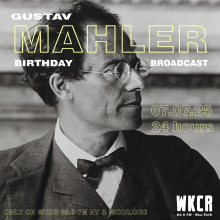
WKCR is pleased to announce a special broadcast in honor of Gustav Mahler’s 165th birthday, for 24 hours on July 7, 2025. The special broadcast will preempt all regularly-scheduled Monday programming and feature both his masterpieces and lesser-known works.
Gustav Mahler was born in Kaliště, Bohemia––an area of the Austrian Empire now located in the Czech Republic––on July 7, 1860. Recognized young as a talented pianist, he attended the Vienna Conservatory and the University of Vienna, where he honed his interest in German philosophy, literature, and the music of composers like Wagner and Bruckner. Dismayed by his rejections as a composer while in school, Mahler began a career as a conductor in the summer of 1880. He gained positions of increasing importance at major theaters and opera houses in Prague, Leipzig, Budapest, and Hamburg. In 1897, Emperor Franz Joseph I appointed Mahler to be the artistic director of the Vienna Court Opera, a position which he held for 10 years (645 performances). Mahler then relocated to the United States, becoming artistic director of the Metropolitan Opera (1908) and the New York Philharmonic (1909). He passed away in Vienna on May 18, 1911.
Mahler’s legacy is principally that of an orchestral composer. Little output survives from the first decade of his career. His first three symphonies (1888-96) are often grouped as the first of three trilogies. Mahler’s fourth symphony (1900) represents the fiercest departure from the massive scale usually associated with his orchestration and works. The decade which he spent in Vienna yielded his fifth, sixth, and seventh symphonies. The Song of a Thousand, Mahler’s eighth symphony (written 1906), represented the first work in his final creative period, followed by his tone poem Song of the Earth (1908) and Symphony No. 9 (1909). The composer began work on his tenth symphony in the summer of 1910, but never completed it.
Though Mahler’s symphonies were received with hesitation and indifference during his lifetime, today they are widely considered some of the finest orchestral works ever written. Laden with philosophical meaning and religious context, Mahler’s works transcended and bridged the end of the romantic period with the start of modernism. Mahler’s work as a composer was––and continues to be––a key influence on countless composers, including Schoenberg, Shostakovich, and Bernstein. His symphonies remain some of the most frequently performed in the world.
It is our honor to participate in the celebration of Gustav Mahler. Listeners can tune into the birthday broadcast on 89.9FM or stream it live on our website, wkcr.org. Follow WKCR on Instagram (@wkcr) and Twitter (@WKCRFM) for updates about this special broadcast and future events. Online listening is available 24/7 at wkcr.org via our web stream.
Schedule of works
Please note that our schedule is subject to change. All times are listed in Eastern Time.
12 midnight - 3 AM: Symphony No. 6, Das Lied von der Erde
3 AM - 6 AM: TBA
6 AM - 9 AM: Symphonies No. 2 and 10
9 AM - 12 noon: TBA
12 noon - 3 PM: Symphonies No. 1 and 5
3 PM - 6 PM: Symphonies No. 8 and 9
6 PM - 9 PM: TBA
9 PM - 12 midnight: TBA