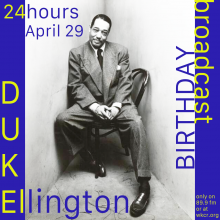
WKCR is thrilled to announce a special 24-hour broadcast on April 29th, 2026 celebrating the 127th anniversary of the birth of Duke Ellington (1899-1974).
Edward Kennedy Ellington was born in Washington D.C. to James and Daisy Ellington who were both pianists. They raised him with racial pride as to protect him from the Jim Crow laws of the era, sophisticated and elegant manners, and a dapper style which earned him the nickname “Duke” from a young age. Ellington started piano lessons at the age of 7 and developed a love for the instrument upon sneaking in to Frank’s Holiday Poolroom at the age of 14. Though he had other strong interests including baseball and visual art (he turned down an art scholarship to the Pratt Institute in Brooklyn in 1916), piano won his attention and he started gigging professionally in the D.C. area in high school.
Ellington moved out of his parents’ place after high school and started his first ensemble, “The Duke’s Serenaders” in 1917. They earned fans as far out as Virginia and were atypical for performing in front of both Black and White audiences when most crowds were segregated at the time. When his drummer Sonny Greer took up a job in New York City, Duke followed him and settled in Harlem. He joined a bustling community of Black musicians, artists, dancers, and other creatives in New York, ultimately become a notable figure in the Harlem Renaissance. In the early 20s, Duke’s bands (which went by many names including “The Washingtonians” and “The Harlem Hot Chocolates”) developed a name for themselves thanks to their unique blend of Harlem street rhythms, growling and moaning trombone, high-screaming trumpet, and bluesy woodwind lines.
In October 1926, Ellington entered a contract with Irving Mills who ultimately earned him his iconic run at Harlem’s Cotton Club until 1931 where he expanded his smaller groups into what would continue to be known and immortalized as the Duke Ellington Orchestra. He signed with Brunswick records from 1932-1936, ending in part from the recording industry crisis during the second world war. The orchestra took to European tours which increased their public image, delighting Mills. The later half of the 1930s also saw a return of Ellington’s smaller ensembles and featured many of his keystone members such as Johnny Hodges, Cootie Williams, and Barney Bigard.
In 1939, Billy Strayhorn joined the Ellington organization after meeting Duke backstage at a show in his hometown of Pittsburgh. Though originally hired as a lyricist, the Duke-Strayhorn collaboration would remain an imperative part of Ellington’s sound as they split responsibilities as composers, arrangers, and bandleaders. The 1940s saw the birth of the “Blanton-Webster Orchestra” named for bassist Jimmy Blanton and tenor saxophonist Ben Webster, marking a significant shift in the use of the double bass in the orchestra. They released many classic Ellington compositions on the Bluebird label including “Cotton-Tail”, “Harlem Air Shaft”, “Jack the Bear”, and the long-standing Ellington theme song (written by Strayhorn and detailing directions to Duke’s Harlem apartment), “Take the ‘A’ Train”. Former theme songs of the Ellington Orchestra included “East St. Louis Toodle-Oo” and “Sepia Panorama”, both composed by Ellington.
Ellington’s music was historic for expanding the typical length of a track on an LP through various suites he composed for his orchestra–though the true history is from the content of this music which often merged classical and jazz genres and commented on the history and reality of the African American in the United States. The most notable of these works was “Black, Brown, and Beige” which premiered in Carnegie Hall on January 23, 1943. Duke famously did not finish writing all the members’ parts until they were in the wings, about to walk onstage. Duke’s sophisticated, eloquent, elegant, and classy composure often covered up his truthfully secretive and seductive nature which he only revealed to those closest to him. Other famous Ellington suites include “The Shakespearean Suite”, “The Far East Suite”, “The Queen’s Suite”, “The Latin American Suite”, “The New Orleans Suite”, “The Peer Gynt Suite” inspired by the work of Edvard Grieg, and “The Nutcracker Suite” inspired by the work of Pyotr Ilyich Tchaikovsky.
After a period of unrest in the orchestra due to the 1942-44 recording ban, heavy military enlistment, and departure of many notable personnel, the Ellington Orchestra saw a revival at the 1956 Newport Jazz Festival featuring his work “Diminuendo and Crescendo in Blue” in which tenor saxophonist Paul Gonsalves gave his famous 27-chorus blues solo. George Avakian went on to produce a record of the performance which became the best-selling LP of Ellington’s career. It was around this time that Ellington and Strayhorn took on various film and television scoring projects which produced “A Drum is a Woman”, “Anatomy of a Murder”, and “Paris Blues” among others.
In 1965, at the age of 66, Ellington was famously not awarded the Pulitzer Prize for Music despite his unanimous election by the board. Ellington famously attributed his loss to “fate [who] doesn’t want me to be famous too young.” Ellington was quick to move on, and in September of the same year he premiered the first of his renowned Sacred Concerts–to him, the most important thing he ever did. He passed away on May 24, 1974 due to lung cancer and pneumonia at the age of 75. His funeral held over 12,000 attendants at the Cathedral of St. John the Divine. Ellington won a total of 14 Grammys, won the Grammy Lifetime Achievement Award, holds 5 honorary degrees, was awarded the Presidential Medal of Freedom, and was awarded the Spingarn Medal from the National Association for the Advancement of Colored People. He also leaves behind his autobiography, “Music is my Mistress”.
We love Duke madly here at WKCR where his legacy lives on, beyond category. Listeners can tune in on 89.9FM or stream the birthday celebration live on our website, wkcr.org. Follow WKCR on Instagram (@wkcr) and Twitter (@WKCRFM) for updates about this special broadcast and future events. Online listening is available 24/7 at wkcr.org via our web stream