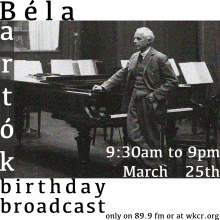
WKCR is pleased to announce a special broadcast in honor of Béla Bartók’s 145th birthday, from 9:30 am to 9 pm EST on March 25, 2026. The special broadcast will preempt all regularly-scheduled Wednesday programming and feature both his masterpieces and lesser-known works.
Béla Bartók was born in the town of Nagyszentmiklós, in the Kingdom of Hungary—present-day Sânnicolau, Romania––on March 25, 1881. Recognized early as a talented pianist, he studied composition and piano at the Royal Academy of Music in Budapest, where he developed a strong interest in the music of Richard Strauss and other late Romantic composers. His time as a student also sparked his interest in Hungarian folk music. In 1908, Bartók and fellow composer Zoltán Kodály traveled through rural Hungary in a groundbreaking partnership to collect and analyze folk music, using a phonograph to document traditional songs and dances. It is for this work that Bartók is remembered as a founder of ethnomusicology.
Bartók’s career combined his work as a composer, performer, and scholar. He served as a professor of piano at the Budapest Academy of Music from 1907 to 1934, while also touring Europe and the United States as a celebrated concert pianist. Over the course of several decades, Bartók compiled and analyzed thousands of folk melodies from Hungary, Romania, Slovakia, Turkey, and North Africa. His distinctive style fused this extensive folk melody research with modernist harmony and rhythm. Influenced by contemporaries such as Igor Stravinsky, Claude Debussy, and Alban Berg, Bartók’s work explored dissonance, asymmetrical rhythms, and atonality.
Bartók’s major works span a wide range of genres, including orchestral, chamber, and solo piano music. Among his best-known compositions are the Concerto for Orchestra (1943), Music for Strings, Percussion and Celesta (1936), the six string quartets (1908–39), and the ballet The Miraculous Mandarin (1926). In 1940, as political tensions mounted in Europe during World War II, Bartók emigrated to the United States. He spent his final years in New York, where illness limited his activity but he continued composing, completing works such as the Third Piano Concerto (1945). His final era of American composition is known for lyrical and structurally clear works, even as they retain Bartók’s quintessential percussive sound. Bartók died in New York on September 26, 1945.
Though some of Bartók’s music was considered difficult by audiences during his lifetime, today he is widely recognized as one of the most important composers of the twentieth century. His innovative synthesis of folk traditions with modernist techniques helped redefine the possibilities of musical language in the modern era. Bartók’s work as both composer and ethnomusicologist has had a lasting influence on generations of musicians and scholars.
It is our honor to participate in the celebration of Béla Bartok. Listeners can tune into the birthday broadcast on 89.9FM or stream it live on our website, wkcr.org. Follow WKCR on Instagram (@wkcr) and Twitter (@WKCRFM) for updates about this special broadcast and future events. Online listening is available 24/7 at wkcr.org via our web stream.